Upcoming Events

Cloud Connect
Santa Clara
Feb 13-16, 2012

Cloud Connect brings together the entire cloud eco-system to better understand the transformation we're experiencing and promises to be the defining event of the cloud computing industry. Learn about the latest cloud technologies and platforms from thought leaders in Cloud Connect’s comprehensive conference.

Register Now!

More Events »

Subscribe to Newsletter

  • Keep up with all of the latest news and analysis on the fast-moving IT industry with Network Computing newsletters.
Sign Up

Email Email  Print  Share


FlashSoft Says Not When Flash, But Where

Tags: , ,

Channel: Tapes and Disks, Storage & Mgmt, Servers & Storage

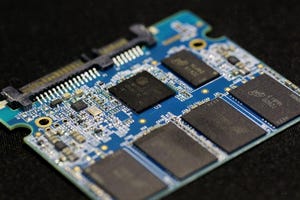
While solid-state disk (flash memory) sales are still just a small fraction of hard drive sales, they are growing rapidly, with average annual unit growth of 90% and revenue growth of 55% between 2010 and 2015. So it's no longer a case of if flash will become a major component of enterprise storage, but where, says Silicon Valley startup FlashSoft. The company is exiting stealth mode with what it calls the first commercial offering for "flash virtualization." FlashSoft SE for Windows Server 1.1.0 is an all-software, hardware-independent, "tier-minus-one" caching approach that eliminates the I/O bottleneck without the cost of putting all data onto flash memory and without disrupting server-tier applications, data structures or underlying storage infrastructure.

The company has two customers using its offering in production, and they are reporting a 10 to 100 times performance improvement over flash sitting in storage arrays below the SAN. The company says benchmark OLTP testing shows it delivers four times faster performance and handles workloads with 75% less storage overhead.

FlashSoft credits Fusion IO for paving the way for moving data back to the server two years ago, and now it's doing the same thing for SSDs with its software-only approach. Rather than putting all of an application's data onto flash, it's tier-minus-one concept puts just the hottest data onto flash, caching the 20% of an application's data that makes up 80% of the server I/O, where I/O runs in microseconds.

FlashSoft SE has been in beta for the last five months and is available for a free 30-day trial. A VMware version is slated to be released at the end of summer or early fall, preceded by a Linux beta, say company officials. Current hardware partners include LSI and SanDisk, but the company is working with a number of others and will offer "tuned" versions that will deliver better results as they become available.

Mark Peters, senior analyst, Enterprise Strategy Group, calls FlashSoft's approach intriguing. "Of course, we've gotten used to what SSD acceleration of I/O in the server can do for performance because of, for instance, Fusion IO, and look at their valuation. FlashSoft is essentially delivering on the same concept but using software that can work with basically any type/vendor's SSD. It then adds shareability for networked storage environments and a bunch of smart software features, ... which has to be attractive."

SSD in the server is a good idea because the latency involved in going through a shared storage controller is minimized, says Jim Bagley, senior analyst and business development consultant, Storage Strategies NOW. "FlashSoft is in a good position, having focused on Windows Server 2008 R2 and Hyper-V for their first release. Others working in this field, like IOTurbine, are doing VMware first."


Page:  1 | 2 |Next Page »

Related Stories

Related Reading


More servers-storage Insights


Currently we allow the following HTML tags in comments:

Single tags

These tags can be used alone and don't need an ending tag.

<br> Defines a single line break

<hr> Defines a horizontal line

Matching tags

These require an ending tag - e.g. <i>italic text</i>

<a> Defines an anchor

<b> Defines bold text

<big> Defines big text

<blockquote> Defines a long quotation

<caption> Defines a table caption

<cite> Defines a citation

<code> Defines computer code text

<em> Defines emphasized text

<fieldset> Defines a border around elements in a form

<h1> This is heading 1

<h2> This is heading 2

<h3> This is heading 3

<h4> This is heading 4

<h5> This is heading 5

<h6> This is heading 6

<i> Defines italic text

<p> Defines a paragraph

<pre> Defines preformatted text

<q> Defines a short quotation

<samp> Defines sample computer code text

<small> Defines small text

<span> Defines a section in a document

<s> Defines strikethrough text

<strike> Defines strikethrough text

<strong> Defines strong text

<sub> Defines subscripted text

<sup> Defines superscripted text

<u> Defines underlined text

Network Computing encourages readers to engage in spirited, healthy debate, including taking us to task. However, Network Computing moderates all comments posted to our site, and reserves the right to modify or remove any content that it determines to be derogatory, offensive, inflammatory, vulgar, irrelevant/off-topic, racist or obvious marketing/SPAM. Network Computing further reserves the right to disable the profile of any commenter participating in said activities.

 
Disqus Tips To upload an avatar photo, first complete your Disqus profile. | View the list of supported HTML tags you can use to style comments. | Please read our commenting policy.


 

Research and Reports

Hypervisor Derby
August 2011

Network Computing: August 2011

TechWeb Careers