Special Coverage Series

Network Computing

Special Coverage Series

Commentary

Howard Marks
Howard Marks Network Computing Blogger

EMC Amps Up Flash Product Line

EMC announced new high-performance PCIe SSDs to extend its range of flash drives, and said its all-flash array, XtremIO, is now available for customers. The company also rebranded its server-side caching software.

EMC yesterday announced a slew of news about its flash product lines. The biggest news is that the all-solid-state XtremIO scale-out array is moving from beta test to a controlled introduction, where customers can actually order it. EMC also announced it's expanding its range of PCIe SSDs, now called XtremSF. The company is also re-branding its server-side caching software from VFcache to XtremSW.

I've written about XtremIO before, most recently here. XtremeIO's scale-out Fibre Channel architecture fits EMC's customers well. The future of storage is definitely scale out, and established storage vendors will have to develop, or acquire, purpose-built, all-solid-state systems like XtremIO to compete.

More Insights

Webcasts

More >>

White Papers

More >>

Reports

More >>

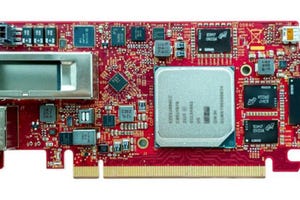
Much of EMC's presentation centered on server-side flash. The company announced four new PCIe SSDs with capacities from 550 Gbytes to 2.2 Tbytes. The new SSDs all have x8 host interfaces, while some competitors use just four lanes. I, for one, am in awe of a multiterabyte SSD, even if EMC's 2.2 Tbytes don't challenge the 11-Tbyte behemoth Violin Memory announced this week.

In a break from EMC's past practices, the company will sell the PCIe SSDs alone for use as direct-attached storage or with other applications. In another break from EMC's past practices, it presented some benchmark data comparing the new XtremeSF cards to Fusion-io cards (thinly veiled as "Brand F").

While EMC didn't announce a new version of the artist formerly known as VFcache (now XtremSW), it did talk about a roadmap that includes coherent cache support via replication for clustered application like Oracle RAC, mirrored HA server-side caching and pooling. This is much like Virident's FlashMAX Connect.

The fact that EMC's new PCIe SSDs use eMLC flash, rather than the more expensive SLC, proves that the SLC era in the data center, short as it was, is coming to an end. When EMC first started shipping SSDs for its arrays, it went to great lengths to describe them not as SSDs but as EFDs (enterprise flash drives) that used the good stuff (SLC flash) and were an entirely different animal than the pedestrian MLC SSDs you'd put in a server.

Over the years, flash controller technology has advanced to the point where even hardcore enterprise applications can run on eMLC, and even MLC, flash-based devices provide the three- to five-year lifetimes customers require. Secondarily, the market has also been educated to the realities of write endurance exhaustion, so users aren't demanding SSDs that last forever.

Missing from these announcements was any mention of EMC's "Project Thunder," which was to provide a very low-latency, shared flash environment that would link multiple servers via Infiniband to a box full of PCIe SSDs. I was never a fan of the whole Thunder idea because a group of servers could instead use server-side cache management software and a LUN from an all-flash array like XtremIO. Sure, it would have 1 to 5 microseconds of additional latency, but I could also use the shared flash array for other things, rather than buying a special-purpose box.

As EMC rolled out Thunder to beta users, the company discovered that users either wanted the extremely low latency of local PCIe flash, or data management features such as snapshots and replication that an array provides. Thunder was neither fish nor fowl, and is now sleeping with the fishes (alongside Luca Brasi).


Related Reading


Network Computing encourages readers to engage in spirited, healthy debate, including taking us to task. However, Network Computing moderates all comments posted to our site, and reserves the right to modify or remove any content that it determines to be derogatory, offensive, inflammatory, vulgar, irrelevant/off-topic, racist or obvious marketing/SPAM. Network Computing further reserves the right to disable the profile of any commenter participating in said activities.

 
Disqus Tips To upload an avatar photo, first complete your Disqus profile. | Please read our commenting policy.
 

Editor's Choice

RESEARCH: 2013 Backup Technologies Survey

RESEARCH: 2013 Backup Technologies Survey

Think backups are boring? Not so, say more than 500 IT pros. Most, 60%, use two, three or even more different backup applications, and the percentage encrypting all media has jumped 15 points since 2011.
Get full survey results now! »

Digital Issue: The Standardization Debate

Digital Issue: The Standardization Debate

An IT infrastructure constructed from uniform blocks of hardware and software is easier to manage and secure, and new services can be rolled out fast. But giving business units carte blanche can deliver more flexibility, drive innovation and better meets employee needs. Two IT executives square off in this debate, and almost 400 survey respondents weigh in too.
Get the Digital Issue »

WEBCAST: Avoiding Downtime: How Virtualization Can Help In Times of Trouble

WEBCAST: Avoiding Downtime: How Virtualization Can Help In Times of Trouble

Server and storage virtualization can help keep systems alive even in the face of demand spikes, disasters and other troubles. Attend this webcast to learn how virtualization can maximize application availability, create business continuity options for critical apps, and improve disaster recovery.
Register Today »

Related Content

From Our Sponsor

Implementing Energy Efficient Data Centers

Implementing Energy Efficient Data Centers

Electrical power costs over the life of a data center may exceed the initial cost of the IT equipment. As described in this paper, recognizing the appropriate IT design architecture necessary and being able to quantify the potential electrical savings can significantly increase cost savings over time.

Creating Order from Chaos in Data Centers and Server Rooms

Creating Order from Chaos in Data Centers and Server Rooms

IT Professionals who are challenged with managing a chaotic data center - messy racks, sub-standard floor air distribution and cable sprawl - can now leverage innovative methods for dealing with and eliminating the root causes of disorder. This paper outlines the solutions available to help create an organized data center.

High-Efficiency AC Power Distribution for Green Data Centers

High-Efficiency AC Power Distribution for Green Data Centers

In order to create optimal electrical efficiency and simplified data centers, the use of 240 volt power distribution is highly recommended. This paper describes the various configurations for this distribution architecture as well as the quantified benefits. Note: Applicable to North America only.

Energy Efficient Cooling for Data Centers: A Close-Coupled Row Solution

Energy Efficient Cooling for Data Centers: A Close-Coupled Row Solution

The trend of increased heat densities in data centers has held consistent with advances in computing technology. As power density increased, the degree of difficulty in cooling these higher power loads was also increasing. This article discusses the efficiency benefits of row-based cooling compared to two other common cooling architectures.

Data Center Projects: Standardized Process

Data Center Projects: Standardized Process

As the design and deployment of data centers evolve into more complicated projects, the benefits of a standardized and predictable process are compelling. This paper presents an overview of a standardized, step-by-step process methodology that can be adapted and configured to suit individual requirements, thus reducing costs and eliminating waste.